Friday, 19 October 2012

BEING CHEEKY AGAIN – Braised Beef Cheeks

Braised Beef Cheeks

The very first time I ate braised beef cheeks was in a little hard-core Spanish tapas restaurant in Kensington market back in Toronto. The dish was aptly called “tongue and cheek”. I have been eating tongue all my life (insert cheeky remark here), but cheeks were a novelty indeed. Incidentally, my choice of menu items that night had prompted the chef himself to come out into the dining room to see for himself who was ordering his “ballsy” dishes. I must mention, I also had the bull’s testicles, they were absolutely divine.
Oh, I was hopelessly absolutely smitten with the beef cheeks and from that point on every time I saw this beautiful item on a menu, it had my name on it. Le Select restaurant in Toronto does a wonderful job with this dish, so if you have not tried it, I highly recommend you give it a go.
Needless to say, when I spotted beef cheeks in Farro’s meat section I pounced on them like a cat, then looked around nervously to make sure no one had spotted my over-eager display of supermarket hunting prowess. I bought home this beautiful piece of meat not really knowing how to prepare it, so I resorted to my fuzzy recollection of Le Select’s tour de force. I have made it very regularly since and I promise you it is the most unctuous and elegant cut of beef you can imagine.

Ingredients:

(serves 4)
3 TB olive oil
3 .5 to 4 lb of trimmed beef cheeks
2 carrots – cut into medium slices
One roughly chopped onion (alternatively use a leek, or 8 whole shallots)
2 cloves garlic - crushed
1 bottle of red wine (Merlot/Cabernet/Malbec)
A few sprigs fresh thyme 
1 TB butter
Salt and Pepper

  •  First, preheat the oven at 160C or 325 F.
  • Now you will need to trim as much of the fat off the cheeks as you can without cutting away too much of the meat. This can be tricky with cheeks so using a combination of sharp knife and kitchen scissors can be more effective here. 

  • Season the cheeks with salt and pepper. In a large heavy bottomed pot, preferably cast iron, brown the cheeks in the olive oil, then set aside.
  • Throw in the onions, carrots and garlic into the same pot the cheeks were browned in and let cook for about 2-3 minutes.
  • Add the beef cheeks back into the pot, throw in the thyme sprigs and let the flavours marry for a minute. 
  • Pour in the wine making sure all the ingredients are fully covered.
  • Place lid over your pot and pop into the oven for 2.5 -3 hrs. turning the cheeks over now and again.
  • Once done, remove the cheeks and carrot chunks and cover in foil to keep warm.
  • You will be left with a nice rich liquid but to make an extraordinary sauce simmer the liquid on medium heat until reduced to about 1/3.
  • Stir in the butter just before removing from heat. Strain the jus. You now should have a rich and glossy sauce to pour over your cheeks.
Serve with couscous, mashed potatoes, parsnip or celeriac puree. Anything mild or sweet that can absorb the sauce well and compliment the beef cheeks.

I hope you enjoy this French classic as much as I do.

Thursday, 13 September 2012

IT STINGS, IT BURNS, BUT IT’S OH SO GOOD


Stinging Nettle Soup and Nettle Purée with Bacon and Scallops


It is Spring here in New Zealand and Spring always compels me to put into practice my belief in eating local seasonal food. Nothing, and I mean nothing, can be more seasonal and more local than stinging nettles found in some park nearby. Most people might only recognize stinging nettles as pesky plants that will cause you some serious discomfort when touched. However not many know that stinging nettles are not only edible but sublime. In some countries, usually in countries where people have no other option but to eat seasonal foods, these are a highly anticipated healthy Spring delicacy. Sadly, in affluent countries, the incentive to find seasonal foods is nil as there is no real demarcation of seasonality in supermarkets.


I grew up eating nettle soup in Romania. After a long Winter in the absence of fresh greens and vegetables (we pickle pretty much everything we can get our hands on in the Autumn to keep us fed through the Winter months), nothing gives your vitamin and mineral deprived body a better kick-start than fresh young nettle leaves. I can go on and on about all their various health benefits but I’ll name just few here; nettles have copious amounts of iron, vitamins A and C, potassium, manganese, calcium and are rich in protein.


This is in no way a rant on being environmentally responsible or being all health-nutty, these are just the side benefits of eating this delightful leafy green. I am first and foremost keen on flavour and it just so happens that local seasonal food has the best flavours. Nettles have the intense taste of spring, a flavour you simply must try and are worth any small effort you make trying to track them down and pick these prickly little suckers.

As I mentioned on an earlier post, I love to scavenge for my food, I look forward to it and come Spring I am like a kid in a candy store. Armed with a plastic bag and my pink rubber cleaning gloves I venture out into nature’s bounty.


Where and when to find them (100% guaranteed):
Auckland – Cornwall Park near the Archery grounds - September/October
Toronto – Riverdale Farms along Lower Road – April/May


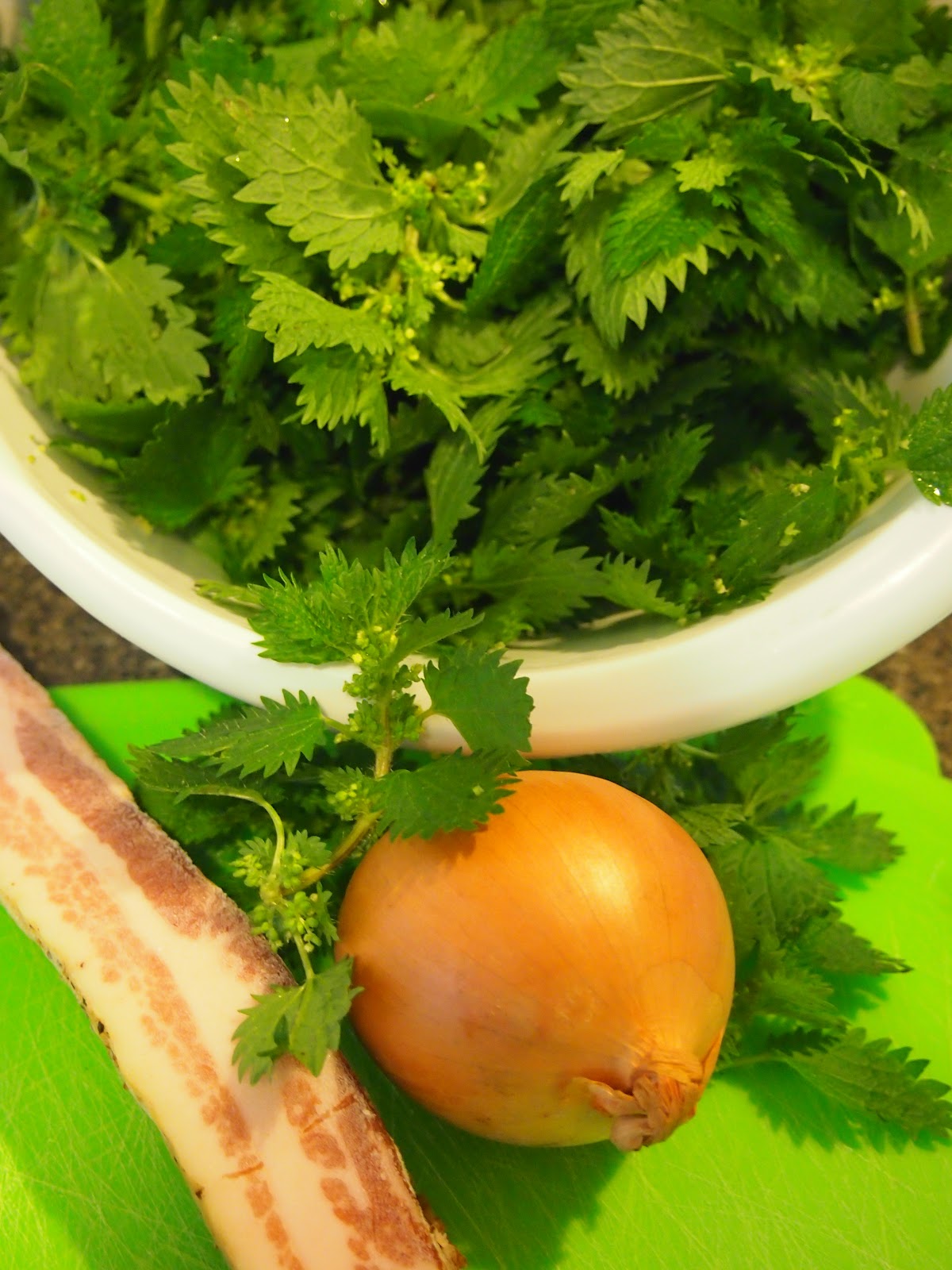
My stinging nettle stash , Cornwall Park


Tips:


  •  Pick only young shoots
  •  Use gloves at all times when     
  •  handling the nettles
  •  Despite their stinging disposition when  raw, soaking nettles in water or cooking them will remove the stinging chemicals from the plant, which allows them to be handled and eaten without incidence of stinging.


Now that you've picked your leaves, and washed them thoroughly, it’s time to make magic. Here are two simple recipes for nettles. The first is the Romanian soup recipe I grew up on and was passed down to me from my mother. The second is a nettle purée and scallop entrée I developed as a way to celebrate the best of Spring.


Stinging Nettle Soup / “Ciorba de Urzici”

Ingredients:


A large bowl-full of nettle leaves
1 Onion, finely chopped
100 g Bacon or pancetta, chopped into cubes
1 Egg yolk
½ Lemon
2 Tb. sour cream


  • Sauté the bacon and onions in a soup pot until the bacon is browned and  onions are translucent
  • Add water, bring to a boil, then salt the water
  • Add the nettle leaves
  • Let simmer for 1 hour
  • Turn off the heat.
  • In a separate bowl, lightly beat an egg yolk and the juice of half a large               lemon, then take a ladle-full of the soup broth and add it to the bowl with the yolk, whisk it lightly and pour it back into the soup pot
  • In a separate bowl, whisk the sour cream and a ladle-full of the soup broth and then add it back  to the soup.

Enjoy with a crusty slice of fresh bread!


Nettle Purée with Bacon and Scallops

Ingredients:


1 cup of vegetable stock and 1 cup of water (or 2 shallots finely chopped and 2 cups of water)
3 cups of young stinging nettle leaves
½ a potato, chopped in mid-sized cubes
Lemon to taste
2 Tb. butter
2 wide slices of bacon
A dozen scallops


·       


  • In a small pot heat up 1.5 cups vegetable stock. If you have not made any just sauté some chopped shallots and then add 1.5 cups of water which you will bring to a boil. This second option will yield a subtler flavour but is good nevertheless.
  • Throw in half a chopped potato, add about 3 cups of nettles, turn down the heat and let simmer until the liquid is reduced significantly.
  • Once a thicker consistency is reached, season with salt, pepper. Take this to a blender and puree. Here you may add some butter and squeeze a bit of lemon to your desired taste.
  • Transfer the purée back to the pot and continue simmering it for another few minutes, stirring occasionally. Adjust seasoning to taste.
  • Meanwhile, stick a couple of slices of bacon on a baking sheet and pop them into the oven until crisp.
  • Then fry some salt and pepper seasoned scallops in hot butter. Only a minute or two on each side depending on their size. I like to squeeze some lemon into the butter sauce so I can drizzle it over the scallops and puree afterwards.


  • Make a little pool of nettle purée on your platter, set the bacon on top and then line the scallops on top of the bacon.
  • The flavours here go so well together particularly, when you have some crusty bread to scoop the purée up with. Enjoy as a first course or light lunch.

Monday, 3 September 2012

ALLORA, WHY GET ANGRY WHEN YOU CAN GET ARRABBIATA?


Arrabbiata and Other Tomato Pasta Sauce Basics


My Spaghetti all'Arrabbiata (but if you're a purist use Penne)

Years ago when I lived in Germany, I used to travel to Italy incessantly. When not heading down to bella Italia, we had Italia head up to us. This was an informative period for me. It was the time I learned how real pasta dishes ought to taste and how to make them. Mostly I learned it from my ex who lived in Italy at one time and who had various Italian friends coming and going, imparting their pasta know-how.  Out of all the things I learned to make in that period of my life, nothing has given me more mileage than the knowledge of how to prepare various pasta dishes.


So when you find yourself, as one often does, with nothing in the refrigerator, when you are tired from a long day of work, when you have impromptu guests coming over, or when you’re just lazy, you can count on penne all’arrabbiata or bucatini all’amatriciana just to name a couple, to save the day.

Arrabbiata means angry (fem.) in Italian because this sugo or sauce is made with hot chillies. I will focus on the arrabbiata sauce here because it is a good example of a basic tomato-based sugo.  This is a very easy dish but it’s the little things that make it magical. So here are a couple of tips to keep in mind if you want your pasta dish to taste like the real thing:

1.      Use only Italian passata, or canned pomodori pelati/peeled tomatoes. Passata di pomodoro refers to tomatoes that have been "passed" through a sieve to remove seeds and lumps. In this form, it is generally sold in bottles. It is uncooked and contains no additives. Do not make the mistake of using tomato paste or prepared tomato sauce. I know local is better, and then there’s the carbon footprint dilemma, and so on, but trust me and make an exception with the tomatoes. It really tastes infinitely better so look for the Made in Italy seal.

Pomodori pelati, passata, and peperoncini

2.      The best chillies to use are these little hot dried bird's eye chillies. If using chilli flakes, it would take quite a lot of them to bring in the heat. You can also use fresh bird eye chillies. The important thing to remember is that the chillies have to be red and very hot so it takes only a few to render a spicy sauce without altering the taste.
Fresh bird's eye chillies
Dried hot peperoncini


3.      Whatever the cooking time instructions are on the pasta box, take it out half a minute earlier because you will need to transfer the pasta to the sauce pan where the pasta will continue cooking.


Ingredients (2 portions):
  • 1 large garlic clove or 2 small cloves, chopped
  • Olive oil, 1tbsp
  • Pepperoncini – dried bird eye chillies (I use 2 or 3 as they pack in a lot of heat)
  • 2/3 of a bottle of tomato Passata or 1 can of pomodori pelati (skinned whole tomatoes)
  • 250 g Penne Rigate or Spaghetti (again, use an Italian brand like Barilla or De Cecco)


Making the Sugo all’Arrabbiata:

·         Heat up the olive oil in a skillet and then sauté the chopped garlic and crushed peperoncini for about half a minute

·         Pour in the tomato passsata or canned peeled tomatoes accompanied by about a half a cup of water. If using the whole peeled tomatoes let them cook for about 15 minutes first before mashing them down with a wooden spoon for a smooth texture.

·         Add salt to taste and let the sauce simmer on low heat for about 35 to 40 minutes so that it has had a chance to reduce and become thicker and more concentrated flavour.

·         Place the pasta in a large pot of boiling and well salted water. Remove the pasta from the pot just short of the recommended cooking time and transfer it to the pan where the sauce is cooking. Be sure not to drain the pasta completely as you need to bring with it some of the starchy water it has been cooking in (about 2-3 tbsp.)

·         Stir the pasta through the sauce making sure it’s covered well, about half and minute. This process will ensure the pasta and sauce are cooking and emulsifying together.
·         Take off the heat and transfer to plates. Garnish with grated Parmigiano Regiano, olive oil, chopped flat parsley, and then tuck into this hot little number.


OTHER TOMATO SAUCE VARIATIONS:

As mentioned earlier, using this sauce as a base you can make a variety of other pasta dishes (just be sure to cut back on the chillies). For example, add 2 tbsps. of ricotta cheese towards the end of the cooking time of your tomato sauce. Alternatively, you can add some cream at the end for a creamy rose sauce. Or you can easily make one of my favorites, Spaghetti all’ Amatriciana by starting out the dish by frying up a handful of diced pancetta, guanciale (see Real Cheeky Carbonara blog post)  or double smoked bacon, then continuing in the same way as above with the garlic and tomato passata.

Farfalle or bow-tie pasta with tomato ricotta sauce

Wednesday, 15 August 2012

Quiche Me Twice, I'm European!


Cultural norms are so unfixed and so relative that I often find myself in inevitably awkward situations, particularly in countries where there are no strict set of social norms (generally in the New World), such as greeting people via kisses on the cheek. I cannot count the times I reached for the second kiss only to be left hanging or alternatively, going in for the other cheek and realizing the receiver has already moved on.  When in Canada or in New Zealand I still have not figured out what is the preferred greeting, one kiss on the cheek or two, or none? I miss the clarity of European customs where one knows exactly what to expect in the respective country. No matter, I shall do it my way and stick to two of everything, like it or not.

Where am I going with this you may ask? I am about to talk about quiche and I don’t want to stick to just one kind. I love it far too much and you know if I make two types of quiches for you, I must be fond of you.

As I said, I love quiche, but for years now I had the worst luck trying to find a decent one, let alone an edible one. They often tend to be soggy and tasteless. Why? What’s so hard about making a proper quiche? After years of hesitantly ordering quiche in various cafés and restaurants (the Quiche Lorraine served for brunch at Le Select in Toronto is an exception) I have given up on the hope of finding something I like, so a few years ago I started making my own. The heavenly aroma wafting through your home is worth the small effort, trust me.

Maronen
My two favorite quiches are Quiche Lorraine and Mushroom Quiche.  Quiche Lorraine is a classic, made with bacon or lardons, while the mushroom quiche is really my own thing. I like to forage, did I tell you? Yea, there is nothing tastier or more rewarding than food that you’ve picked yourself. Oh yea, and I am a bit of a Fungophile as well. I love picking mushrooms, it reminds me of long Autumn walks through the Odenwald, a forest range that extends into the Heidelberg area in Germany where I used to live, with basket and knife in hand trying to spot Steinpilze (Porcini mushrooms) and Maronen (Bay Bolete mushrooms). These are some of the tastiest mushrooms there are. Absolutely divine in a stew!

I had a blast this fall in Auckland trying to find mushrooms but too nervous to pick them as I am unfamiliar with mushrooms in this part of the world. Luckily, I live near the beautiful Cornwall Park and there is a sweet spot in the olive grove where I find (safe-to-eat and easily-identifiable) Wood Ear mushrooms found growing happily on rotting wood. I made many a dish using the Wood Ear which is mostly valued for its texture and health properties - A. auricula-judae has antitumour, hypoglycemic, anticoagulant and cholesterol-lowering properties.  I particularly like using in as part of the mélange of mushrooms in my quiches.

Wood Ear Mushrooms

I have been away from New Zealand for the winter and now that I am back at its tail-end I have been surprised to find that my wood ear mushrooms have had a second wind. Normally they are ripe for the picking in the autumn but on my walk through the park the other day I found them alive and well. How could I resist?


Making the Pastry Base:

·         In a food processor pulse: 200g cold butter (cubed), 400g flour, pinch of salt, until the pastry begins to clump together, kind of like loose moist sand

·         In a cold bowl: pour in the contents of food processor and form a well, then pour in 100ml of water and mix gradually by hand

·         Sprinkle a clean surface with flour and transfer the loose pastry mixture to it for light kneading, ultimately forming a ball.

·         Cut ball in half and re-form both halves into balls

·         Cover them with plastic wraps and place in refrigerator for at least 30 minutes, or store in freezer if not using it immediately. The pastry will make two quiches.


Quiche Loraine

·         In a pan, melt 10g of butter then brown about 100g cubed bacon, pancetta or speck

·         Once the bacon is fried use some of the remaining fat in the pan to oil the inside of your quiche pan using a paper towel

·         Roll out the ball of pastry on a floured surface so that it is about 2.5 inches wider than the diameter of your pan.

·         Place the rolled out pastry into the oiled pan pushing securely against the edge of the pan.

·         Using a fork, prick holes into the bottom of the pastry.

          Distribute the cooked bacon and its oil over the surface of your pastry

          In a bowl whisk: 3 eggs, 200g crème fraiche (alternatively use table cream), salt and pepper to taste, and a sprinkle of nutmeg

         Pour the custard into the pastry-lined form
     Grate on a bit of Edam or Gruyere cheese

·         Place the pan in a preheated oven at 185 C or 360 F for about 50 minutes (you should check that the top of the quiche does not burn).


Mushroom Quiche:

·         In a pan, melt a tablespoon of butter and add some finely leek or chopped shallot, a bunch of sliced melange of mushrooms (ie. Cremini, Oyster, and Wood Ear), and sauté until all are softened and cooked through. Half way through throw in some chopped herbs like rosemary, thyme or sage, or even better, all three.

·         Season well with salt and pepper.

·         In a bowl whisk: 3 eggs, 200g crème fraiche (alternatively use table cream), salt and pepper to taste, and a sprinkle of nutmeg

·         Pour the custard into the pastry-lined form

·         Place the pan in a preheated oven at 185 C or 360 F for about 50 minutes (you should check that the top of the quiche does not burn).
Now, take a moment and relish the heavenly aroma that your home has been anointed in, take the quiche out of the oven, and let cool down a bit before slicing.

Mwah, mwah. Enjoy!


Wednesday, 11 July 2012

It’s flat, it’s white … yea, yea, yea

Have a coffee, this might take a while.


 The beginning of the love affair. Naples, Italy, 2002

I relish my coffee, however I am not a fan of  the filtered kind as I find it watery and far too heavy on the caffeine.  In Toronto, I relied on a few sublime coffee houses to feed my yearning, nay, my right to this dark, rich, hypnotic master. However, for my quotidian consumption I rely on my faithful macchinetta for my espressos, café lattes, cappuccinos and cortados. Coffee is so important to me it seems that even while selecting a travel destination, the availability of good coffee factors in, albeit unconsciously, more than I care to admit.  It is no wonder then that for the past five years in a row I managed to somehow end up in Spain.


 The fruit of my humble macchinetta

But New Zealand, really? Not for a millisecond did I suspect it! I am certain that my earlier and very mistaken conviction of this country’s mediocre cuisine would somehow extend to coffee, kind of like Canada.  After all, culturally we have the same roots. Yes, I blame Britain. I had visions of bad filtered Irish Cream flavoured coffees likened to the “pisswasser” one readily finds in Canada (Tim Horton’s anybody?). I am sure this contributed to my growing anxiety before moving down here. I continue to be proven wrong, oh so wrong.


A few of the many lovely coffees I've enjoyed  around NZ

The last thing I expected would be that NZ would be the hidden epicentre of coffee culture, nearly rivaling those which I considered to be the kings of kings, Italy and Spain. You know you are in the presence of greatness when they have even coined their own coffee, the flat white.


A flat white

 I mean, it’s not like there are just a handful of really good coffee houses sprinkled around the city centre, the kind of destination spots you can only access when you’re in the area if you’re not lucky enough to live in hipster-land, as is the case in Toronto. Oh no, it’s far more democratic than that. Everyone gets access to the good stuff, everywhere! Just drop by a BP station for a fill-up and you’ll get a damn good cappuccino, no problem.

A BP station in Auckland adversising their flat white coffee

What is going on here? Could it be some kind of a small man complex? To go so far as to train gas station attendants to use real espresso machines and then have them actually turn out a decent latte!  I’ll need to dig deeper.


So it appears that in the last couple of decades, New Zealand has undergone a coffee revolution as many Kiwis have become connoisseurs of coffee. The increased popularity of coffee has prompted a growth industry with new cafés and coffee roasting outlets springing up all over the country. Coffee-making is also very competitive, with baristas vying to make the perfect cup of coffee and coffee drinkers becoming very selective in their choice. So far, not much different from Toronto, except that Starbucks hardly stands a chance in NZ. I wonder if Starbucks consumers qualify as coffee connoisseurs in Toronto? (I hope not).


A cortado from Altezano in Auckland

New Zealand coffee connoisseurs will go a long way to get their daily caffeine fix, and favoured cafés can be anything from a‘hole-in-the-wall’ or mobile outlet just big enough to accommodate a good coffee machine and its skilled operator to stylish venues with lounge-style seating serving gourmet treats and meals. Here’s where they’ve really got it right. I mean good coffee is very accessible in NZ, particularly when you factor in the dozens of coffee mobiles trolling around town ready to dispense their liquid gold. I simply love them!

One of NZ's many coffee mobiles, fitted with the finest Italian espresso hardware

You didn’t know, did you?

New Zealand baristas have consistently shown their passion and expertise scoring in the top ten at world competitions since 2002.

New Zealand has more roasters per capita than anywhere in the world, and The Coffee Lovers lay claim to the fact that Kiwi coffees are also the best in the world.

The flat white debate
New Zealand has also gained notoriety on the world's coffee scene having been credited with pioneering the "flat white" - traditionally a less milky brew with textured rather than frothy milk.
The flat white is enjoying new popularity in Britain and the United States, attributed not just to the demand from the number of Aussies and Kiwis travelling overseas, but also the many Australasians who work as baristas in cities like London and New York.
But wait, the Kiwis have landed here too! I’ve been alerted by my friend T that there are some new players in town like Te Aro. I trust her judgement when she tells me they are extraordinary and yes, Torontonians can finally experience the joys of the flat white now (http://www.te-aro.ca/pages/about-us).


Midway through my delightful flat white at Te Aro, Toronto


New Zealand coffee terminology:

  • espresso / short black - basis for all coffee styles, espresso is full-flavoured, fragrant, with a velvety body and lingering after-taste; single serving in a demi-tasse (small cup)
  • macchiato - a single or double espresso shot, just stained with frothed milk
·         long black - single serving of espresso, with the same amount of hot water added; served in large cup filled to just under the top, or sometimes with the water provided separately
·         flat white - one third espresso, two thirds steamed milk with a touch of swirled froth
·         cappuccino - regular espresso with equal parts steamed milk and foam, sprinkled with chocolate or cinnamon
·         caffe latte - regular espresso, topped with hot milk and little or no froth
·         mochaccino - one third each of espresso, steamed milk, cocoa
·         ristretto - (‘restricted’) is 15-20ml of espresso, the essence of coffee
·         piccolo latte - miniature latte made with ristretto and 70ml of steamed milk; delicate flavoursome drink
·         espresso Romano - espresso served with a twist of lemon
·         latte macchiato - steamed milk with espresso on the side
·         espresso con panna - espresso topped with a dash of whipped cream
·         cortado - Spanish version of the piccolo served in a 60ml demitasse cup
·         fluffy - for kids, a demi-tasse filled with foamed milk, sprinkled with chocolate and served with marshmallow on the side and a small chocolate fish.


It’s a good thing I am in Toronto this month I really miss the flat white.

And if you don’t know, now you know.


Source:

www.newzealand.com/travel/media/features/food-&-wine/food&wine_new-zealands-coffee-scene_feature.cfm